
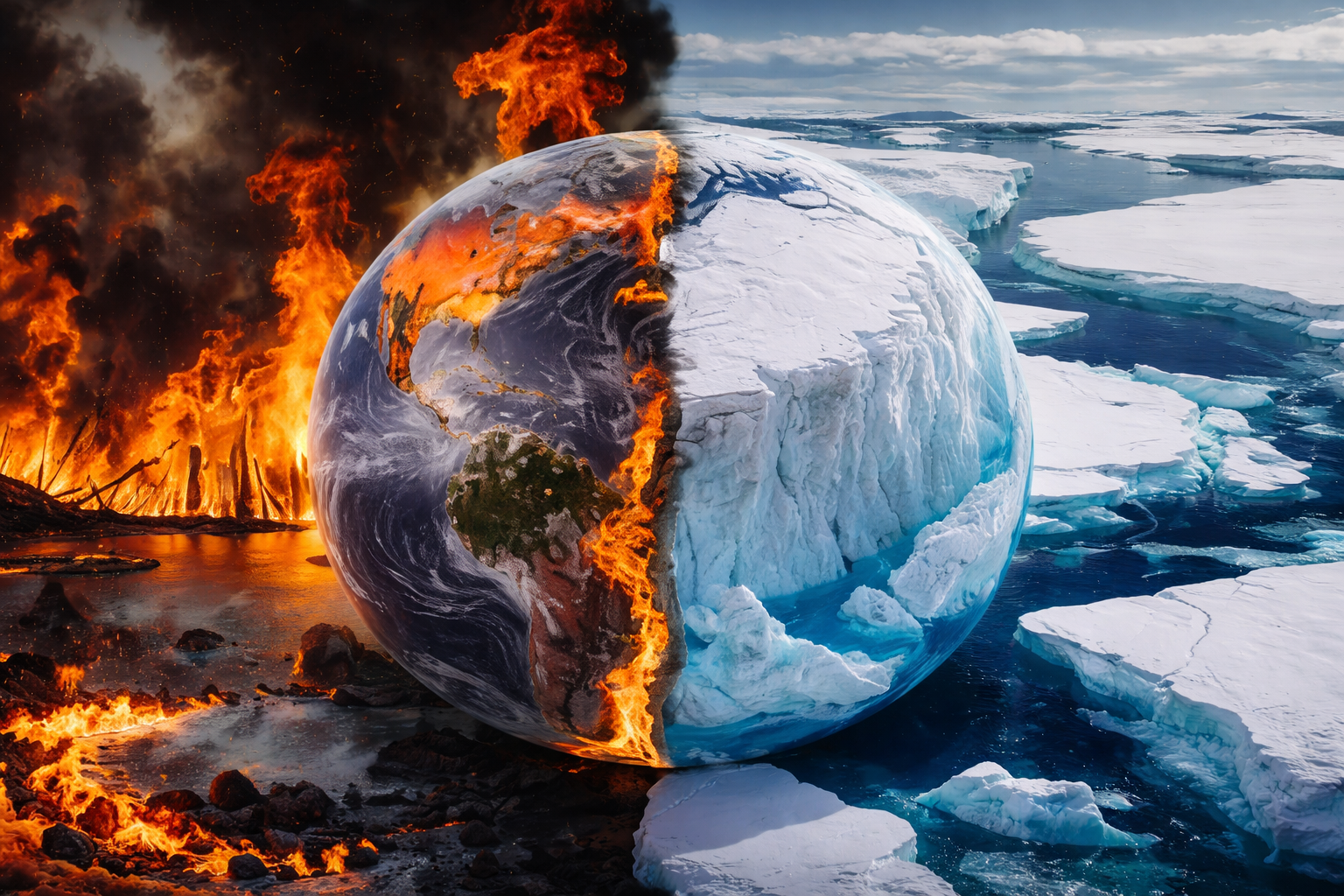
SF₆: The Longest-Lived Climate Threat You’ve Never Seen
A Gas Designed for Stability — Released into an Unstable System
Modern climate discussions focus on carbon dioxide and methane. They dominate headlines, policy debates, and emission targets. Yet there exists another greenhouse gas, far less discussed, that is orders of magnitude more potent per molecule and almost permanent once emitted. Sulfur hexafluoride — SF₆ — is not a byproduct of nature. It is a fully synthetic industrial gas. Every molecule in the atmosphere today was created by human engineering.
Unlike carbon dioxide, which cycles between atmosphere, oceans, and biosphere, SF₆ does not meaningfully cycle. Unlike methane, which breaks down over about a decade, SF₆ persists for approximately 3,200 years according to atmospheric assessments. This means that emissions released today will still be contributing to radiative forcing in the year 5200.
It is not dramatic. It is structural.

What SF₆ Is — And Why Industry Uses It
SF₆ is a sulfur–fluorine compound composed of one sulfur atom surrounded symmetrically by six fluorine atoms. This configuration makes it extraordinarily stable. It does not react under normal atmospheric conditions. It is non-flammable, non-corrosive, and an exceptional electrical insulator.
Because of these properties, SF₆ became the preferred gas for high-voltage electrical equipment. It is widely used in:
Roughly two-thirds of global emissions originate from the electricity sector. Power grids worldwide rely on it to prevent electrical arcs.
Technically, it is brilliant. Environmentally, it is persistent.

Atmospheric Presence: Small Concentration, Enormous Impact
SF₆ exists at approximately 12 parts per trillion (ppt) globally as of 2025. That number seems negligible. That number seems negligible. For comparison:
CO₂ ≈ 420 parts per million (420,000,000 ppt)
Methane ≈ 1,900 parts per billion
SF₆ ≈ 12 parts per trillion
Yet concentration alone does not determine climate impact. Radiative efficiency — how effectively a molecule traps infrared radiation — is the decisive factor.
Over a 100-year period, the Global Warming Potential (GWP) of SF₆ is approximately 23,500 times that of CO₂.
This means:
1 kilogram of SF₆ ≈ 23.5 tonnes of CO₂ in warming impact.
Even small annual emissions accumulate meaningfully over time because the gas remains in the atmosphere for millennia.
Quantitative Emission Perspective
Global SF₆ emissions are estimated at roughly 8,000–9,000 metric tonnes per year in recent assessments (including leakage from electrical infrastructure and industrial processes).
When converted to CO₂-equivalent:
9,000 tonnes × 23,500 = approximately 211 million tonnes of CO₂-equivalent annually.
For perspective:
- This is comparable to the annual emissions of a mid-sized industrialized nation.
- And unlike CO₂, which partially cycles out over centuries, SF₆ does not meaningfully decline on human timescales.
Its annual volume is small. Its lifetime multiplies its significance.
Why SF₆ Does Not Destroy Ozone — But Still Matters
SF₆ has essentially zero ozone depletion potential. It contains no chlorine or bromine, which are responsible for ozone breakdown. However, ozone safety does not equal climate safety. SF₆’s danger lies exclusively in its greenhouse strength and persistence.

Radiative Forcing and Climate Amplification
When SF₆ accumulates in the atmosphere, it absorbs infrared radiation emitted by Earth’s surface. This traps heat in the lower atmosphere, increasing radiative forcing.
Even though SF₆ contributes a smaller fraction of total greenhouse forcing compared to CO₂, its persistence means that its forcing does not decline. Each year’s emissions add to an almost permanent atmospheric burden.
This additional forcing contributes to:
- Increased global average temperature
- Amplified heatwaves
- Polar ice melt acceleration
- Ocean heat uptake imbalance
- Increased atmospheric water vapor (a feedback greenhouse gas)
The climate system is cumulative. SF₆ adds a long-term forcing layer on top of existing greenhouse gases.

Impact on Living Systems
Human Systems
SF₆ does not directly poison populations at atmospheric concentrations. Its harm is indirect through warming.
As global temperatures rise:
- Heat-related mortality increases
- Agricultural yields decline in temperature-sensitive regions
- Water stress intensifies
- Energy demand for cooling rises
- Infrastructure strain increases
This creates feedback cycles. Higher energy demand can lead to expanded electrical infrastructure — sometimes using more SF₆-containing equipment.
Non-Human Life
Climate shifts driven by cumulative greenhouse gases impact ecosystems:
- Coral bleaching due to ocean warming
- Polar habitat loss from cryosphere destabilization
- Migration pattern shifts
- Species pushed beyond thermal tolerance
Because SF₆ persists for thousands of years, it extends warming pressure across many future generations of ecosystems.
Comparison: SF₆ vs CO₂ vs Methane
| Gas | Lifetime | 100-Year GWP | Atmospheric Concentration |
|---|---|---|---|
| CO₂ | Variable (centuries) | 1 | ~420 ppm |
| Methane | ~12 years | ~28–30 | ~1.9 ppm |
| SF₆ | ~3,200 years | ~23,500 | ~12 ppt |
CO₂ dominates due to volume.
Methane dominates short-term forcing due to potency and volume.
SF₆ dominates per-molecule persistence.
CO₂ can partially cycle into oceans and vegetation.
Methane oxidizes into CO₂.
SF₆ essentially waits.
The “Chain Reaction” Question: Does SF₆ React Dangerously?

Chemically, SF₆ is extremely inert. It does not spontaneously react with atmospheric atoms under normal conditions. It does not create explosive chain reactions in the air. It does not break apart easily.
Its danger is not chemical reactivity.
Its danger is chemical stability.
The molecular structure shields sulfur from reaction, preventing breakdown in the troposphere. Only extremely high-energy ultraviolet processes in the upper atmosphere slowly degrade it over thousands of years.
So there is no violent atomic chain reaction.
The chain reaction is climatic, not chemical:
- SF₆ traps infrared radiation.
- Warming increases water vapor.
- Ice melts, reducing albedo.
- Oceans absorb heat, expand thermally.
- Feedback loops amplify warming.
That is the real systemic reaction.
Future Risk: Locked-In Warming

Well, No single gas will independently cause planetary collapse.
But cumulative forcing from multiple long-lived greenhouse gases can push the climate system toward destabilizing thresholds.
Because SF₆ lasts thousands of years:
- It commits the planet to warming long beyond policy cycles.
- Even if global emissions stopped tomorrow, existing SF₆ remains.
- Every additional tonne today adds multi-millennial forcing.
That is structural risk.
Can SF₆ Be Reversed?
Unlike CO₂, which can theoretically be captured and stored, SF₆ exists at extremely dilute concentrations. Extracting it from the open atmosphere would require enormous energy input and cost.
The only viable strategies are:
- Strict leak detection in existing infrastructure
- Replacement with vacuum or alternative gas technologies
- Regulatory reporting improvements
- Industrial capture and recycling
- Phase-out in new grid installations
Prevention is the only meaningful form of reversal.
Final Assessment: A Long-Term Climate Liability
SF₆ is not dramatic in volume. It does not darken skies. It does not poison rivers. It does not create visible catastrophe.
It accumulates quietly.
At 12 parts per trillion, it seems insignificant. But at 23,500 times the warming power of CO₂ and with a 3,200-year lifetime, it becomes a multi-generational commitment.
If climate policy is about reducing future risk, then ignoring ultra-long-lived gases like SF₆ is structurally dangerous. It is not the largest problem but it is one of the longest. And in climate systems, duration multiplies damage.
The U.S. Environmental Protection Agency describes SF₆ as the most potent greenhouse gas known, with a warming power 23,500 times stronger than carbon dioxide.
NOAA monitoring data show that SF₆ concentrations are steadily rising, and because the gas remains in the atmosphere for millennia, today’s emissions will influence climate systems far beyond this century.
SF₆ does not erupt, spill, or explode — it accumulates.
In a climate system already under stress, permanence is a risk multiplier.
The question is not whether we understand the science, but whether we act before today’s stability becomes tomorrow’s liability.
Leave a Reply